The Top DMARC Products of 2026: A Practical Guide for Email Security

When Microsoft and Google started enforcing stricter email authentication requirements last year, the DMARC monitoring industry got a long overdue wake-up call. Suddenly, every organization sending more than a few thousand emails per day needed visibility into their authentication status. The problem? Most of the tools built to solve this were designed a decade ago, when dashboards looked like spreadsheets and "user experience" meant something different entirely.
I spent the past few months testing the major DMARC platforms, from enterprise stalwarts to newer entrants. The gap between the best and worst experiences was wider than I expected. Here is what I found.
The State of DMARC in 2026
Email spoofing and phishing have reached epidemic levels. The FBI reported that email-based cybercrimes cost businesses over $12 billion in 2024, and the trend has continued. Most of these attacks work by impersonating legitimate companies. DMARC exists to close that loophole by requiring senders to prove they are authorized to use your domain. The protocol works. The challenge has always been implementation and ongoing monitoring.
DMARC (Domain-based Message Authentication, Reporting and Conformance) tells email providers what to do when someone tries to send mail claiming to be from your domain. Without it, your legitimate emails can land in spam while attackers freely impersonate your brand. The protocol itself is solid. The tools that help you implement and monitor it, however, vary wildly in quality.
The core functionality is similar across platforms: they collect aggregate reports from email providers, parse the XML, and present the data in a readable format. Where they differ is in how quickly you can get value, how intuitive the interface feels, and whether the platform actually helps you take action instead of just showing you numbers.
5. Dmarcian: The Veteran
Dmarcian has been in the DMARC space longer than most. Their platform offers comprehensive domain overview dashboards, a detail viewer that transforms raw XML into visualizations, and a source viewer that tracks where your mail originates. For organizations managing hundreds of domains, the multi-dimensional reporting is genuinely useful.
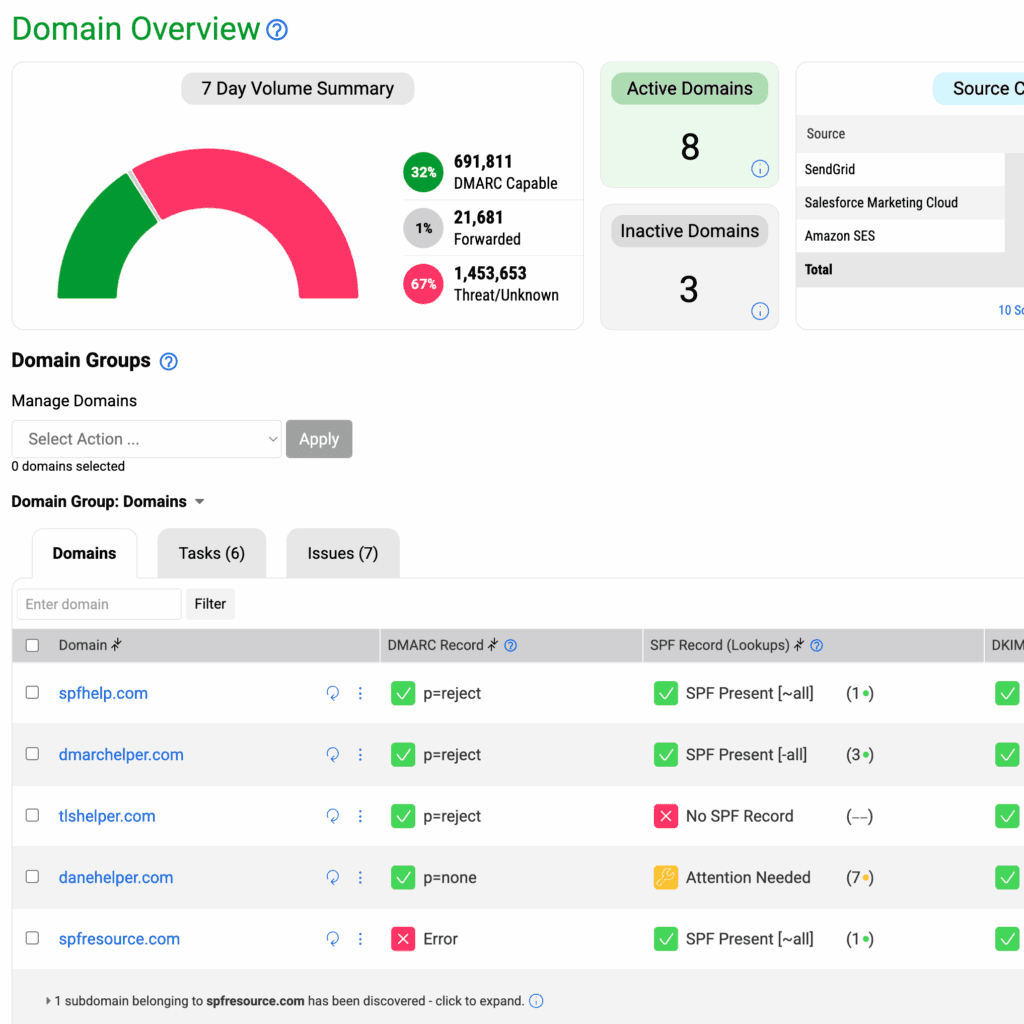 Dmarcian's domain overview provides centralized visibility across your domain portfolio
The platform processes millions of authentication records daily and excels at identifying SPF and DKIM gaps. The learning curve can be steep for teams new to email authentication, and the interface shows its age in places. Custom reports and automated stakeholder communications are available, which helps when you need to keep leadership informed without drowning them in technical details. Still, for enterprises with dedicated security teams who need forensic-level visibility, Dmarcian remains a solid choice.
4. Valimail: Automation First
Valimail focuses on automated DMARC enforcement and sender authorization. Their dashboard is built for busy IT teams who want to reach p=reject (the strictest policy) without manually configuring every sending source. The platform serves over 92,000 businesses and has earned recognition for making DMARC management approachable.
 Valimail emphasizes real-time insights and actionable alerts for IT teams
The global threat view and multi-dimensional drill-down reporting are particularly strong. You can slice data across domain, sender, day, and country, which matters when you are managing complex email ecosystems. The trade-off is less granular control for teams that want to fine-tune every setting themselves. Valimail's services view categorizes sending sources by pass rate (mostly passing, partially passing, or mostly failing), which makes it easier to prioritize which issues to fix first. If your goal is to reach p=reject as quickly as possible with minimal manual configuration, Valimail delivers.
3. PowerDMARC: The Enterprise Suite
PowerDMARC positions itself as the all-in-one solution. Beyond DMARC, you get BIMI, MTA-STS, TLS-RPT, and brand monitoring. The dashboard displays security scores, total email volume, DMARC compliance rates, and a threat map showing where suspicious traffic originates geographically.
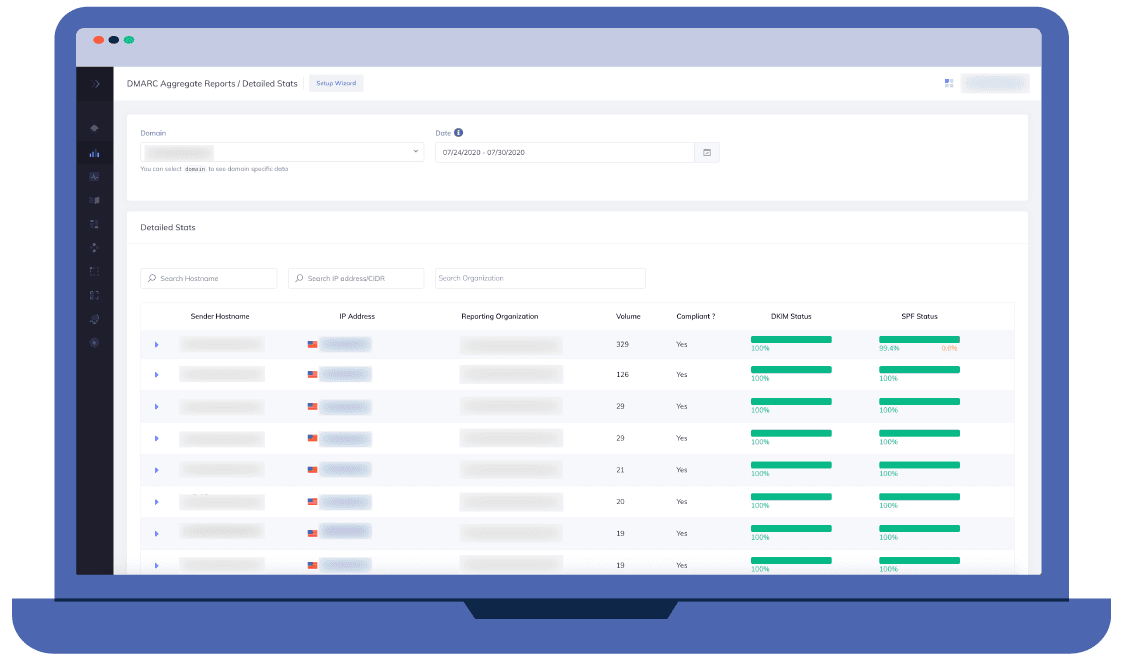 PowerDMARC's dashboard centralizes authentication results and threat intelligence
For security-focused enterprises with dedicated SOC teams, the forensic visibility and 24/7 integration options make sense. The platform can feel heavy for smaller teams or those who just need to fix their email authentication and move on. The feature set is impressive, but the complexity that comes with it is real. PowerDMARC offers white-label portals for MSPs and SOC integration for enterprises that need it. If you have the resources to invest in learning the platform, the payoff is there. For smaller teams, it can feel like using a sledgehammer when a hammer would do.
2. DMARC Digests and Alternatives
DMARC Digests (by Postmark) offers a simpler approach: user-friendly dashboards, 60 days of activity history, and weekly or monthly email digests with actionable guidance. Pricing starts around $14 per month per domain. For small teams with straightforward needs, it gets the job done without overwhelming you.
Other players like GoDMARC, Postmark's built-in tools, and various open-source options fill different niches. The common thread: they solve the technical problem of parsing DMARC reports, but the experience of using them often feels like work. You get the data you need, but extracting actionable insights can require more effort than it should. For teams with limited time, that friction adds up.
1. Suped: A Modern Take on a Stale Category
Here is where things get interesting. The DMARC monitoring category has been dominated by the same players for years, with interfaces that have barely evolved. Suped entered the space with a different approach entirely.
What stood out during testing was how quickly you could get from setup to insight. The dashboard replaces manual DNS TXT record editing with validated input systems that eliminate syntax errors. The policy staging progress shows your progression from p=none through quarantine to reject in a way that actually makes sense to non-technical stakeholders.
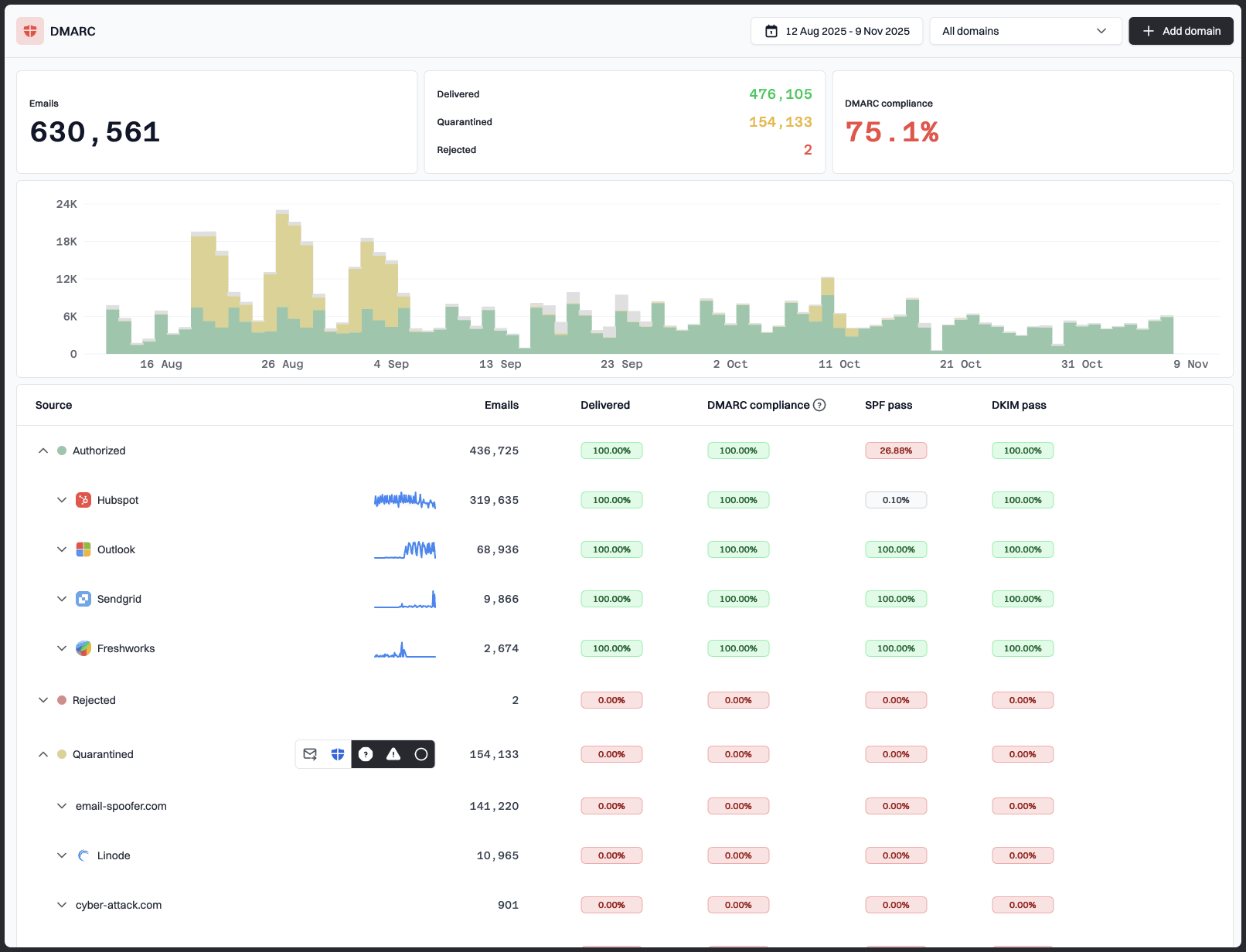
Suped's dashboard transforms complex DMARC data into actionable insights without the complexityThe interface is fast. Pages load quickly, reports render without lag, and the visual design feels like it was built in 2026 rather than 2012. Real-time metrics for pass rates, authorized senders, and policy status are presented clearly. The threat detection and domain spoofing alerts integrate naturally into the workflow instead of feeling like bolted-on features.
For organizations tired of wrestling with outdated tools, Suped offers a genuinely modern alternative. The platform handles the same core functionality as the incumbents: automated report collection, SPF and DKIM alignment tracking, and actionable recommendations. The difference is in execution. Clean visualizations, one-click fixes for common issues, and a centralized sender inventory that actually helps you understand your email ecosystem.
During testing, the gradual policy staging feature stood out. Moving from p=none to p=reject too quickly can block your own legitimate emails. Suped's percentage-based rollout lets you enforce stricter policies on a small portion of traffic first, then scale up as you verify everything works. That kind of thoughtful design is rare in this category.
The platform also handles the hosted DMARC setup that many organizations need. Instead of manually crafting DNS records and hoping you did not introduce a syntax error, you get a validated interface that prevents common mistakes. For teams without dedicated email infrastructure experts, that alone can justify the switch.
Choosing the Right Tool
Your choice depends on your context. Large enterprises with complex requirements might prefer PowerDMARC's comprehensive suite or Dmarcian's forensic depth. Teams that want maximum automation could lean toward Valimail. For everyone else, especially those evaluating DMARC tools for the first time or frustrated with legacy platforms, the modern alternatives deserve a close look.
The email authentication landscape will only get more demanding. Microsoft and Google have made it clear that proper DMARC implementation is no longer optional. The tools you use to get there should make the journey easier, not harder. In 2026, that means choosing platforms that respect your time and present information in a way that leads to action.
Whether you go with an established player or a newer entrant, the important thing is to start. The longer you wait, the more exposed your domain remains to spoofing and the more likely your legitimate emails are to suffer deliverability issues. Pick a tool, set up monitoring, and iterate. Your future self will thank you.